Calvin Coolidge
Donald R. McCoy
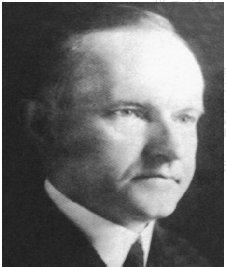
CALVIN COOLIDGE, a shrewd, taciturn, and publicly dignified New Englander, occupied the presidency during the generally prosperous and peaceful period from August 1923 to March 1929. The variety of his accomplishments in the White House was impressive even if their substance was not.
Born in Plymouth Notch, Vermont, on 4 July 1872, he was named John Calvin Coolidge after his father, variously a teacher, storekeeper, farmer, mechanic, and politician, doing whatever would contribute to his modest prosperity. Calvin's mother, Victoria Moor Coolidge, a handsome woman and a lover of poetry and nature, died when the boy was twelve.
Calvin Coolidge's childhood was simple and idealistic. Although his religious ideas were vague, he was taught to believe in a divine intelligence that imposed upon man a duty to give public service. In rugged, rural Vermont, he acquired the attributes of caution, fairness, frugality, honesty, industry, reliability, tolerance, and unpretentiousness. He clung to these qualities throughout his life, and they stood him well in his rise to the presidency. Calvin was the first of the Vermont Coolidges to attend college, going to Amherst College in Amherst, Massachusetts. His Amherst years strengthened his conviction that harmony and stability were essential in the affairs of society. The college also helped him to develop into something of a gentleman, a scholar, an occasionally droll fellow, and an adequate speaker.
After being graduated cum laude from Amherst in 1895, Coolidge read law with John Hammond and Henry Field in Northampton. He was admitted to the bar two years later, after which he opened a law office in Northampton, which he considered his home for the rest of his life. Although he never achieved eminence or riches at the bar, Coolidge was able to earn enough as a lawyer to become financially independent of his father.
BIBLIOGRAPHY
Calvin Coolidge, The Autobiography of Calvin Coolidge (New York, 1929), is dry and only seldom revealing. Have Faith in Massachusetts: A Collection of Speeches and Messages, by Calvin Coolidge (Boston, 1919) and The Price of Freedom: Speeches and Addresses, by Calvin Coolidge (New York, 1924) vary in quality and subject matter; both were intended as election campaign documents.
Claude M. Fuess, Calvin Coolidge, The Man from Vermont (Boston, 1940), is a starchy, almost defensive scholarly biography of Coolidge. William Allen White, A Puritan in Babylon: The Story of Calvin Coolidge (New York, 1938), is superbly written but often inaccurate. Donald R. McCoy, Calvin Coolidge, the Quiet President (New York, 1967; Lawrence, Kans., 1988), is a recent biography of Coolidge. Hendrik Booraem V, The Provincial: Calvin Coolidge and His World, 1885–1895 (Lewisburg, Pa., 1994), and John Almon Waterhouse, Calvin Coolidge Meets Charles Edward Garman (Rutland, Vt., 1984), are good accounts of Coolidge's formative years.
Philip R. Moran, ed., Calvin Coolidge, 1872–1933: Chronology, Documents, Bibliographical Aids (Dobbs Ferry, N.Y., 1970), and Clifford A. Pease, Jr., Calvin Coolidge and His Family: An Annotated Bibliography (Plymouth, Vt., 1987), are useful to anyone interested in Coolidge studies. Robert K. Murray, The Politics of Normalcy: Governmental Theory and Practice in the Harding-Coolidge Era (New York, 1973), provides a general background to the policies of Coolidge's presidency.
Edward Connery Lathem, ed., Your Son, Calvin Coolidge: A Selection of Letters from Calvin Coolidge to His Father (Montpelier, Vt., 1968), is a fine collection of letters, sometimes witty, sometimes sad, but almost always revealing of Coolidge's personality. Howard H. Quint and Robert H. Ferrell, eds., The Talkative President: The Off-the-Record Press Conferences of Calvin Coolidge (Amherst, Mass., 1964), offers splendid documentation of how Coolidge handled the press and is also valuable for the content of the president's comments. C. Bascom Slemp, ed., The Mind of the President, as Revealed by Himself in His Own Words (Garden City, N.Y., 1926), is a mundane but thoughtful selection of Coolidge's comments. Ishbel Ross, Grace Coolidge and Her Era: The Story of a President's Wife (New York, 1962), a good popular biography, supplies interesting insights into the life of the Coolidge family.
Recent works include Robert H. Ferrell, The Presidency of Calvin Coolidge (Lawrence, Kans., 1998); Peter Hannaford, comp. and ed., The Quotable Calvin Coolidge: Sensible Words for a New Century (Bennington, Vt., 2001), and Robert Sobel, Coolidge: An American Enigma (Washington, D.C., 1998).
~Natalie Portman